Features
Part of Image rights guide: copyright, privacy, publicity, contract, confidentiality, data protection
Portrait Rights Dispute Case: A Fictional Scenario
A fictional portrait rights dispute case separates copyright, release scope, agency authority, advertising claims, payment, correction, and removal.
What to take away
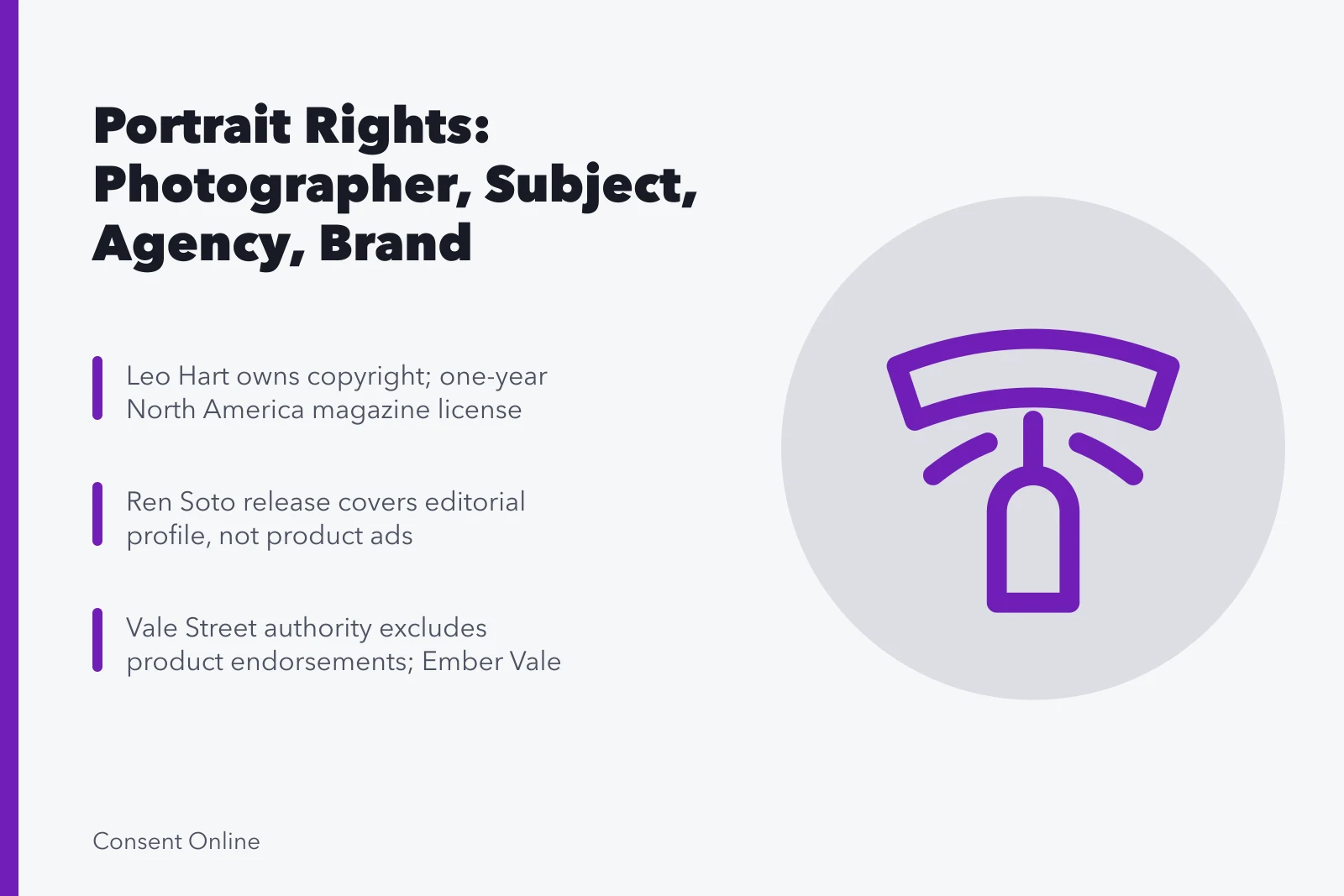
- The fictional photographer owns the image copyright under the available records.
- The subject's release covers an editorial profile but not a later product advertisement.
- The agency has authority to license a magazine use, not every commercial use.
- The brand's invoice proves payment but not a broader grant than the signed schedule.
- The parties separate removal, correction, license fees, and future-use controls.
- The case resolves by agreement without declaring how a court would rule.
This fictional portrait rights dispute case illustrates how to sort the issues. It does not determine legal liability. The people, image, agency, publication, brand, agreements, and products are invented.
The project
Photographer Leo Hart creates a portrait of musician Ren Soto for an editorial profile commissioned by Vale Street Agency. The signed documents include:
Four Documents, Four Scopes
Document
- Photographer agreement
- one-year print/web license
- Subject release
- capture and publication
- Agency appointment
- arrange editorial publicity
- Invoice
- production fee
Main scope
- Photographer agreement
- North America
- Subject release
- named profile
- Agency appointment
- for Ren
- Invoice
- licensed uses listed
| Document | Main scope |
|---|---|
| Photographer agreement | one-year magazine print and web license, North America, editorial profile |
| Subject release | capture and publication for that named profile and magazine promotion |
| Agency appointment | authority to arrange editorial publicity for Ren |
| Invoice | production fee and licensed uses listed in the photographer agreement |
Ten months later, beverage brand Ember Vale places the portrait on a paid social ad beside a product slogan. The magazine supplied the image after the brand sponsored an event.
Separating the claims
Leo objects to copying and advertising outside his license. Ren objects to an implied product association beyond the release. Vale Street says it never approved a beverage endorsement. Ember Vale points to its paid sponsorship invoice, which mentions "campaign assets" but does not identify the portrait or grant rights.
The U.S. Copyright Office's photograph registration page confirms that photographic works are a recognized registration category and distinguishes published and unpublished group routes. The parties use it only for procedural context; registration does not decide the subject release or brand association.
For registration, the U.S. Copyright Office offers a Standard Application and, when eligibility rules permit, Group Registration of Published Photographs or Group Registration of Unpublished Photographs. Each option has its own application and deposit requirements; registration does not determine what a separate contract licensed.
Building the rights table
The parties list each question without collapsing them:
Rights Questions To Separate
- Who created and owns the photograph?
- Which reproduction, display, advertising rights licensed?
- What use of Ren's identity approved?
- What authority did Vale Street hold?
- What did the magazine promise the brand?
- What factual message did the ad communicate?
- Which jurisdictions and platform policies apply?
- Who created and owns the photograph?
- Which reproduction, display, advertising, territory, and term rights were licensed?
- What use of Ren's identity did the release approve?
- What authority did Vale Street hold from Ren?
- What did the magazine promise the brand?
- What factual message did the ad communicate?
- Which jurisdictions and platform policies apply?
Leo supplies source files and the signed license. Ren supplies the release. Vale Street supplies its appointment. Ember Vale supplies the sponsorship agreement, media plan, and ad versions.
Evidence is indexed by document, date, sender, recipient, and disputed use. The team keeps original files untouched and puts annotations in working copies.
An invoice is evidence of a transaction, not automatic proof that every necessary party granted every right. A release answers only the uses and parties its language covers. The team flags missing attachments and unsigned schedules instead of filling gaps with assumptions.
The agency question
Cornell's Legal Information Institute describes agency authority through actual and apparent authority in a U.S. common-law framework. The fictional parties do not assume that a general agency title authorized an endorsement. They examine Ren's conduct, the appointment, the third party's information, and governing law.
Vale Street's written authority covers editorial publicity and expressly excludes product endorsements. The magazine cannot show that Ren or Vale Street approved the beverage ad.
The negotiated response
Ember Vale pauses the ad, preserves placement data, and removes the portrait from its asset library. The magazine asks its syndication vendor to disable the supplied download. Search results are handled only after source pages change.
Real-world routes and legal limits
For a copyright takedown, the copyright owner or an authorized agent can send a notice under DMCA §512(c)(3) to the service provider’s designated agent. The notice identifies the copyrighted work and the allegedly infringing material and its location, gives the sender’s contact information, and includes good-faith and accuracy statements, the latter under penalty of perjury, plus a signature. A notice may lead a provider to remove or disable access to material, but it is not a ruling on ownership or liability. An uploader may submit a counter-notice under §512(g), which can lead to restoration unless the copyright owner takes the required court-action step.
Platform reporting is a separate route. If an ad appears on Facebook or Instagram, Meta has an online intellectual-property reporting channel; the platform’s process is distinct from a DMCA notice and does not resolve a claim about the subject’s identity.
Publicity rights depend on state law. California Civil Code §3344 addresses specified commercial uses of a person’s name, voice, signature, photograph, or likeness without consent. New York Civil Rights Law §§50–51 address specified advertising or trade uses of a person’s name, portrait, picture, or voice without written consent. The laws have different requirements and exceptions, and neither makes every reuse unlawful.
The editorial-to-advertising shift matters, but it does not settle copyright fair use or First Amendment questions by itself. Fair use considers the purpose and character of the use, the nature of the work, the amount used, and the effect on the market; commercial purpose is relevant but not conclusive. In Comedy III Productions, Inc. v. Gary Saderup, Inc., the California Supreme Court applied a transformative-use inquiry to a right-of-publicity dispute involving celebrity images. That case offers a point of comparison, not a decision about this fictional beverage ad or the law of every state.
For an eligible copyright dispute, the photographer could also consider the Copyright Claims Board, a voluntary small-claims forum within the U.S. Copyright Office. It handles copyright claims, not Ren’s publicity or contract claims, and its eligibility rules apply; a respondent may opt out. It is a possible enforcement route, not a guaranteed resolution.
The brand publishes a correction stating that Ren did not endorse the beverage. It pays Leo a negotiated fee for the ten-day past use without receiving future rights. Ren receives a separate payment for resolving the disputed association. The agreements state that settlement is not an admission of liability.
Workflow repair
The magazine adds asset-level rights fields for owner, release, purpose, commercial status, territory, term, and downloadable use. Sponsorship staff cannot select editorial portraits without a new rights review. Vale Street adds a named endorsement-approval contact and a list of excluded categories.
Leo registers future published work on a planned schedule and keeps signed transfers separate from invoices. Ren's team records each approved product, claim, channel, period, and synthetic-use prohibition.
What remains undecided
No court decides infringement, publicity liability, contract breach, apparent authority, damages, or defenses. The settlement solves practical harms while preserving uncertainty about the legal outcome.
Common questions
Did the sponsorship invoice license the portrait?
Not under the fictional records. It did not identify the image, owner, rights, scope, or authorized licensor.
Did Ren own the image copyright?
No transfer to Ren appeared in the facts. Ren still had separate interests in identity and the release scope.
Could the agency approve a future endorsement?
Only if Ren grants valid authority for that use and other required rights are cleared.
Why did Leo accept a fee instead of suing?
That was a business choice based on evidence, cost, speed, uncertainty, and the negotiated controls. It does not predict what another creator should do.