Guides
Image misuse response guide: safety, evidence, platform reports, host notices, search results, copyright
Image misuse response guide covers safety, evidence, platform reports, host notices, search removal, copyright, privacy, escalation, appeals, and follow-up.
What to take away
- Settle physical, account and emotional safety before you contact anyone who posted the image.
- Log the direct page URL, media URL, account identifier, timestamps and the report receipt.
- Pick the report category that fits the harm, filed by the person the service recognizes as authorized.
- Platform, host, search, copyright and privacy routes reach different layers; one does not do another's job.
- Delisting a search result leaves the source page live for anyone with the link.
Unauthorized image use covers several harmful acts:
- Reposting
- Impersonation
- Harassment
- A portrait dropped into an ad
- A private photo paired with a false caption
- Outright copyright theft Some cases are several of those at once. This guide is general information, not legal advice.
Start with safety and scope
Ask what the publication exposes. A home, a workplace, a child, a daily schedule. A medical condition, an intimate context, a threat. If the uploader might retaliate, do not open a direct conversation with them.
Immediate Danger Response
Is danger immediate?
platform safety, law enforcement, helpline
secure account from trusted device
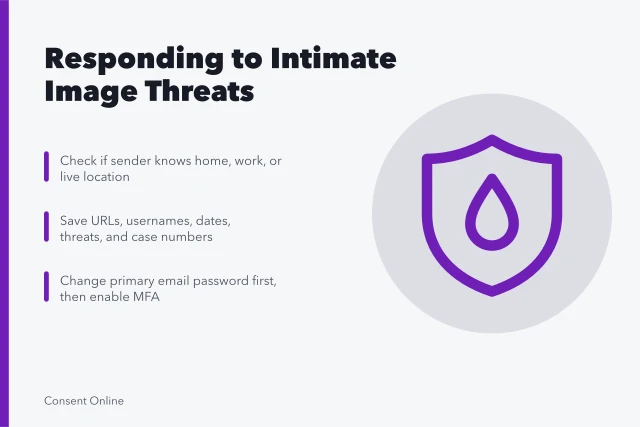
Secure a compromised account from a trusted device, not the one you suspect is watched. When danger is immediate, platform safety teams, local law enforcement and intimate-image support helplines exist for exactly that call. Do not handle a threat alone to keep the case tidy.
Then write the problem in one sentence. "My portrait was copied into a paid ad." "This account claims to be me." "A private event photo shows my address." Each sentence points at a different route.
Build the minimum evidence record
For each item, record:
Minimum Evidence Record
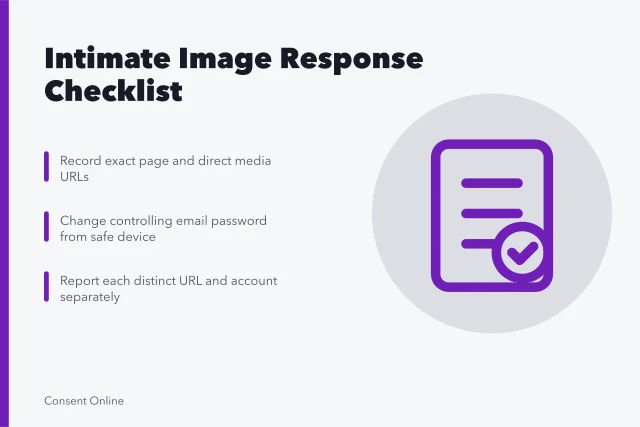
- Direct page and media URL
- Profile URL, username, account identifier
- Publication and observation dates with time zone
- Screenshot showing surrounding context
- Original file or permission record
- Exact false caption or claim, quoted
- Report category, date filed, case number, outcome
Keep one untouched source copy and work from redacted duplicates for everything else. Never circulate intimate content or suspected child sexual abuse material as ordinary evidence. That material goes to the platform safety team, law enforcement or a child-protection authority, not into a shared folder.
Match the route to the layer
What it can address
- Account block
- stops some direct contact or visibility
- Platform report
- applies a service policy to content or an account
- Host notice
- asks the storage or publishing provider to act
- Search request
- delists eligible results from one search product
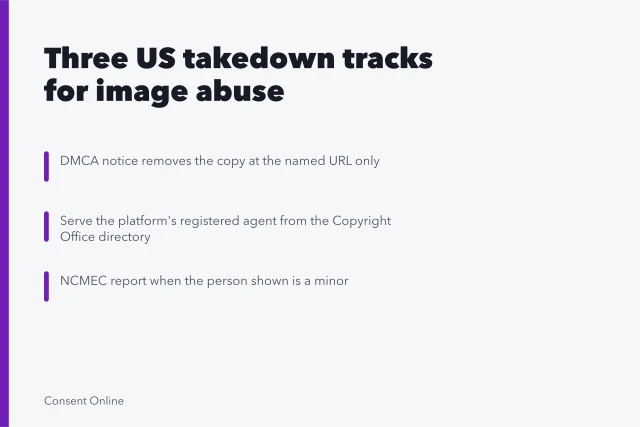
- Copyright notice
- alleges infringement for an owner or authorized agent
- Privacy complaint
- raises unlawful or policy-based personal-data use
- Court or agency order
- seeks enforceable relief within jurisdiction
What it normally cannot do alone
- Account block
- remove public copies for everyone
- Platform report
- delete copies on unrelated services
- Host notice
- remove search listings automatically
- Search request
- erase the source page
- Copyright notice
- resolve subject consent by itself
- Privacy complaint
- establish copyright ownership
- Court or agency order
- guarantee cross-border or mirror removal
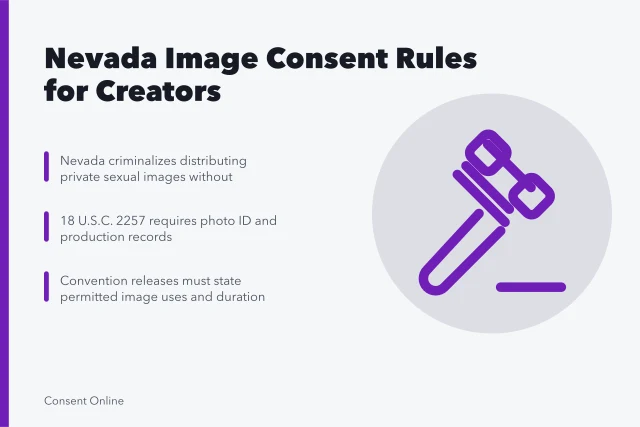
State revenge porn and NCII statutes differ by state. Illinois BIPA governs biometric identifiers, Washington's My Health My Data Act governs consumer health data, and Nevada NRS 200.575 covers unlawful dissemination of an intimate image. Which one reaches your facts, and what it requires, is a question for a licensed attorney in your state.
Write a precise report
Use the service's closest policy category, not the one that sounds most serious. Give the exact URL, name the person or the work, state the narrow problem, and ask for one specific action.
Precise Report Checklist
- Use closest policy category
- Give exact URL
- Name person or work
- State narrow problem
- Ask for one specific action
- Skip speculative accusations and unrelated grievances
- Confirm copyright ownership before filing
Skip the speculative accusations and the unrelated grievances. A reviewer who cannot find the content cannot remove it, and a report with forty links gets triaged as noise.
If you file under copyright, confirm who owns the source image and whether an exception may apply. Being the person in a photograph does not make you its copyright owner.
False statements in a legal notice carry their own risk. Meta, Twitch and Google each publish their own report flows; follow the flow for the service that actually hosts the copy.
Address search separately
After host action, request a refresh or removal from each search service that still lists the page. Google's page on removing web results from Search separates site-owner removal, refresh of outdated results, eligible personal-content requests and legal requests. It does not say that delisting deletes the underlying page.
Search Removal After Host Action
- Host action completed
- Request refresh or removal from each search service
- Record search product and query used
- Repeat for image, web, cached snippets, autocomplete
Record the search product and the query you used. Image search, web search, cached snippets and autocomplete run on separate processes, and a fix in one leaves the others untouched.
Appeal and monitor
Read the rejection reason before resubmitting. It usually names the missing piece: a URL, a proof of authority, the wrong category, an identification the reviewer could not verify.
Do not flood the service with identical reports. Preserve every review message and deadline, because an appeal window that closes is a route you no longer have.
Monitor on a schedule you set in advance. Each new mirror gets a new row in the log. Close a case with a written outcome like "source removed, search refresh pending," never "internet deleted."
Common questions
Should every misuse receive a copyright notice?
No. Use copyright only when the claimant owns or represents the protected work and the facts fit that route. A subject who never held the copyright needs a privacy or policy route instead.
Is a screenshot enough evidence?
It can help, but it is rarely enough alone. A direct URL, account identifier, timestamp, original source and the surrounding context are what let a reviewer act.
Can I ask friends to mass-report the post?
That tends to produce inconsistent reports and can breach service rules. One precise report from the affected or authorized person is usually clearer to the reviewer.
When should a lawyer review the matter?
Consider legal help for threats, commercial loss, urgent orders, or disputed ownership. Also consider counter-notices, defamation, privacy claims, or cross-border questions. A licensed attorney in your jurisdiction can tell you which statute or claim applies.