Features
Coordinating a fictional unauthorized portfolio-copy response across three services case
A fictional studio traces eight copied portraits through platform reports, host notices, and search refresh requests while keeping ownership and evidence straight.
What to take away
- One incident number and one row per copied use keeps eight images from becoming eight separate arguments.
- A model release grants permission to show a portrait; it does not transfer the photographer's copyright.
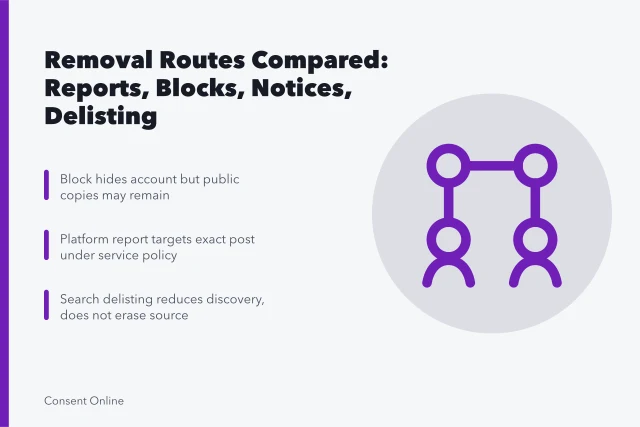
- Platform impersonation reports and copyright notices travel on separate case numbers and need separate evidence.
- A content-delivery network is not automatically the host; the notice goes to the origin host named in the site's records.
- Search refresh requests clear stale thumbnails after a page dies; they do not settle who owns the image.
This fictional case illustrates workflow only. It does not decide infringement, fair use, privacy liability, or any remedy. All people, businesses, domains, accounts, and images are invented. Nothing here is legal advice; copyright, publicity, and privacy claims vary by jurisdiction, so confirm your options with a licensed attorney.
The discovery
Northline Portraits finds eight portfolio photographs copied into a fake booking page. Three also appear on a social account claiming to be the studio. Search results surface both the fake site and image thumbnails.
The studio owner, Jo Bell, assigns one incident number. She pauses public accusations and asks the photographed clients not to forward screenshots. The page exposes no home addresses or intimate material, and no physical threat is known.
Building the matrix
The team creates one row per copied use:
| Field | Example entry |
|---|
Copied-use matrix fields
- Original assetmaster file name
- Original publicationportfolio URL
- Copied pageexact fake-site URL
- Direct imageexact asset URL
- Social postexact post URL
- Ownerverified by creation records
- Statuspending, removed, rejected, appealed
Jo confirms she created and owns seven photographs. The eighth came from a collaborating photographer and is excluded until that photographer decides whether to act.
Track 1: Social platform
The studio submits an impersonation report for the fake account and copyright notices for the seven owned photographs. Each post is reported by URL. The account report and content reports receive separate case numbers.
Social platform report path
- Submit impersonation report for fake account
- Submit copyright notices for seven owned photos
- Report each post by exact URL
- Receive separate case numbers
- Correct rejected reports with direct post links
Two posts are initially rejected because the team supplied profile screenshots but no direct post links. The corrected reports identify the exact locations and original works.
Track 2: Origin site and infrastructure
The visible site uses a content-delivery provider, but the team does not assume that company stores the files. It identifies the origin host from the site's records and sends the host a structured notice.
Identify the origin host
Does the visible site use a content-delivery provider?
Do not assume that company stores files
Check site records for origin host
Cloudflare's guidance on providing specific abuse-report URLs explains that its address may appear because it provides pass-through services and asks reporters for the specific asset URL so it can identify which service it provides. The team uses that distinction to avoid claiming that every network intermediary is the host.
The origin host removes the fake booking page after reviewing the notice. The studio saves the response and checks each source URL directly.
Track 3: Search results
Some thumbnails remain after the page disappears. The team submits stale-result refresh requests for the removed URLs. It does not ask the search service to adjudicate the original ownership dispute through that refresh tool. Each request records the dead source response, prior page address, image result, submission date, and later verification check.
One video compilation remains on a third-party channel. Jo uses the service's dedicated process. YouTube's page on copyright removal requests describes owner or authorized-agent eligibility, consideration of exceptions, information sharing, scheduled requests, and consequences for false submissions. Jo includes only the seven works she owns.
Communicating with clients
The studio tells depicted clients what was copied, where it appeared, and what steps are pending. It does not say the clients own the photographs. A client with a separate privacy or safety concern can choose an independent route.
The public correction states that the booking page and account were unauthorized and names the studio's real contact channel. It does not identify a suspected operator without proof.
Closing the incident
After four weeks, the source page, known social posts, and video are unavailable, and stale thumbnails have cleared. The team closes those exact rows. It retains the incident log and required legal records for a defined term, deletes duplicate screenshots, and keeps no claim that every private copy is gone.
Common questions
Why was the eighth image excluded?
Jo had no verified ownership or authority for it. The collaborating photographer needed to decide whether and how to proceed, and a notice filed without that authority risks a false-submission finding.
Why report the account and posts separately?
The account identity and the individual image uses raise different policy questions and require different location details. One case number covers the impersonation claim; the copyright notices each carry their own.
Did the CDN remove the site?
The case does not say that. The team identified the origin host and kept the intermediary's pass-through role separate, which is why the notice named the specific asset URL rather than the network.
Was the response successful?
The known public URLs were addressed. Attribution, every private copy, and future mirrors remained uncertain, and the studio recorded that gap instead of closing it as resolved.