Maintenance
Part of Image rights guide: copyright, privacy, publicity, contract, confidentiality, data protection
Image rights review checklist: people, rights and evidence
Use this image rights review checklist to cover creators, subjects, owners, licenses, releases, context, rights, evidence, remedies and takedown routes.
What to take away
- Identify every creator, subject, owner, licensee, publisher, and claimant.
- Read the actual license and release instead of relying on a filename or memory.
- Describe publication context, audience, caption, edits, and commercial message.
- Check copyright, privacy, publicity, data, defamation, contract, and platform issues separately.
- Match evidence and remedy to the person authorized to complain.
- Record applicable law and deadlines before sending a formal notice.
Use this image rights review checklist before publishing a risky image or responding to a dispute. It helps organize a qualified review and does not declare that any right or defense applies.
People and authority
People and authority
- Identify camera operator, editor, writer, producer
- Identify every recognizable person
- Confirm age and legal capacity
- Identify employer, client, agency, brand, publisher
- Verify who can sign
- Record present claimant and representative
- Identify the camera operator, editor, writer, and producer.
- Identify every recognizable person.
- Confirm age and legal capacity at relevant dates.
- Identify employer, client, agency, brand, publisher, and platform.
- Verify who can sign for each person or organization.
- Record the present claimant and requested role of any representative.
Ownership and documents
Ownership and documents
- Preserve original files and creation records
- Trace copyright from author through transfer
- Read licenses for rights, media, territory, term
- Read releases for purpose, identity, editing, withdrawal
- Review agency authority and amendments
- Separate copy ownership from copyright
- Preserve original files and creation records.
- Trace copyright from author through employment, assignment, or other transfer.
- Read licenses for rights, media, territory, term, exclusivity, sublicensing, and termination.
- Read releases for purpose, identity use, editing, advertising, approval, and withdrawal.
- Review agency authority and amendments.
- Separate ownership of a physical or digital copy from copyright.
Context and meaning
Context and meaning
- Save exact page, caption, headline, tags, ad
- Record crops, composites, retouching, synthetic changes
- State whether use is editorial or promotional
- Identify audience, paid distribution, location, date
- Check private, medical, financial, child disclosures
- Save the exact page, caption, headline, tags, ad, product, and nearby claims.
- Record crops, composites, retouching, sequencing, and synthetic changes.
- State whether use is editorial, documentary, artistic, educational, internal, or promotional.
- Identify the target audience, paid distribution, location, and publication date.
- Check private, medical, sexual, financial, employment, political, child, and location disclosures.
Rights screen
- Copyrightprotected work, owner, challenged act, license, exception, registration, and remedy.
- Subject permissioncapture and use scope.
- Publicityrecognizable identity, commercial purpose, consent, exception, and jurisdiction.
- Privacycapture method, expectation, facts, audience, public interest, and recognized claim.
- Data protectioncontroller, purpose, basis, notice, recipients, security, retention, and rights.
- Defamationexact factual meaning, falsity, identification, publication, fault, harm, defense, and correction.
- Contractparties, clause, authority, breach, limitation, and remedy.
- Non-consensual intimate imagesthe federal civil action under 15 U.S.C. § 6851, state criminal and civil statutes such as California Civil Code § 1708.85, and the reporting routes set out below.
California's 2026 civil jury instructions include CACI 1804A on misappropriation, which addresses name, voice, signature, photograph, or likeness under California Civil Code section 3344. It is a state-specific instruction set, not a national publicity rule or a finding about any dispute.
Evidence and response
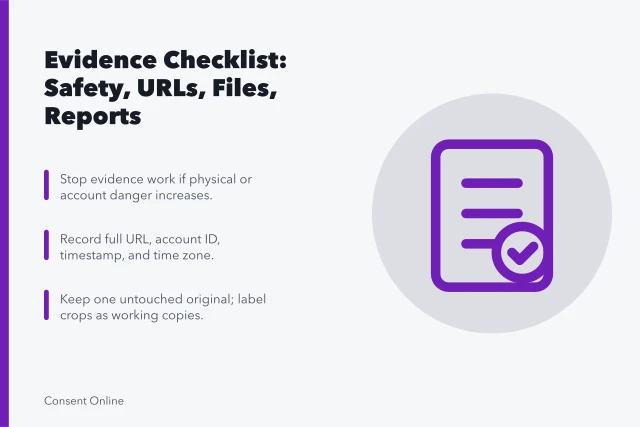
- Record exact page and media URLs, accounts, dates, and time zones.
- Keep one untouched lawful capture and labeled working copies.
- Save a dated public copy through the Internet Archive's Wayback Machine or archive.today, and keep the original file's embedded metadata.
- Match each claim to original, agreement, and publication evidence.
- Preserve report receipts, decisions, counter-notices, and corrections.
- Avoid speculative allegations and public attribution without proof.
- Restrict sensitive evidence access.
Remedy and follow-up
- Define removal, correction, credit, payment, access restriction, preservation, disclosure, or damages sought.
- Identify which recipient controls that remedy.
- Check limitation periods, contractual notice windows, appeal deadlines, and urgent-order requirements.
- Write down the specific clock for each claimthe statutory limitation period, the platform appeal window, and any contractual notice deadline.
- Consider defenses, exceptions, public interest, jurisdiction, and enforcement cost.
- Obtain qualified advice before signing legal declarations.
Notice and takedown routes
- Send a notice under the Digital Millennium Copyright Act, 17 U.S.C. § 512, to the platform's designated agent: identify the copyrighted work, identify the material and where it sits, give contact details, state a good-faith belief that the use is unauthorized, and sign a statement under penalty of perjury that the notice is accurate and that you own the right or act for the owner.
- Look up the registered agent in the DMCA Designated Agent Directory before sending anything, so the notice reaches the person the service has actually named.
- Expect the platform to pass the notice to the uploader, who may file a counter-notice; the material can then go back up unless the dispute moves to court.
- Register the work with the U.S. Copyright Office, which is generally required before a US infringement suit can be filed.
- Use the platform's own reporting form for private or non-consensual material. Section 230, 47 U.S.C. § 230, shields platforms from liability for what users post, but it does not stop them from acting on a valid report.
- For intimate images, use Take It Down, run by the National Center for Missing & Exploited Children, or StopNCII.org, which creates a hash of the image on the person's own device so participating services can block it.
- Ask the platform and the search service that controls the page to remove or de-index it, and keep the case or ticket number for every report you file.
Record the chosen route in the review file. Note who decided, what facts were available, which document controlled, what uncertainty remained, and when to revisit.
A conclusion for one use should not become permission for another campaign, audience, territory, edit, or retention period. If circumstances change, reopen the review and preserve the earlier version instead of overwriting it.
Within the UK framework, the ICO's lawful basis guidance says an organization needs a valid basis for processing personal data and should determine and document it before processing begins. The appropriate basis depends on the purpose and the relationship with the individual, so consent is not the only possible basis.
Common questions
Does a release prove ownership?
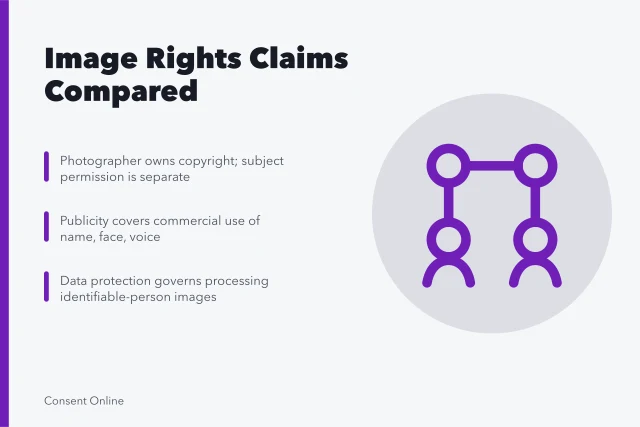
Not necessarily. It may authorize likeness use while leaving image copyright with the photographer or another owner.
Should jurisdiction be checked first?
Check it early because it affects recognized claims, defenses, remedies, formalities, and deadlines.
Can one remedy solve every issue?
No. A correction may address false context, while a license fee, deletion, access restriction, or search request handles another concern.
Is this checklist a legal opinion?
No. It organizes facts and questions for operational or professional review.