Guides
Image rights guide: copyright, privacy, publicity, contract, confidentiality, data protection
Image rights guide separates copyright, privacy, publicity, contract, confidentiality, data protection, defamation, platform rules, claimants, and remedies.
What to take away
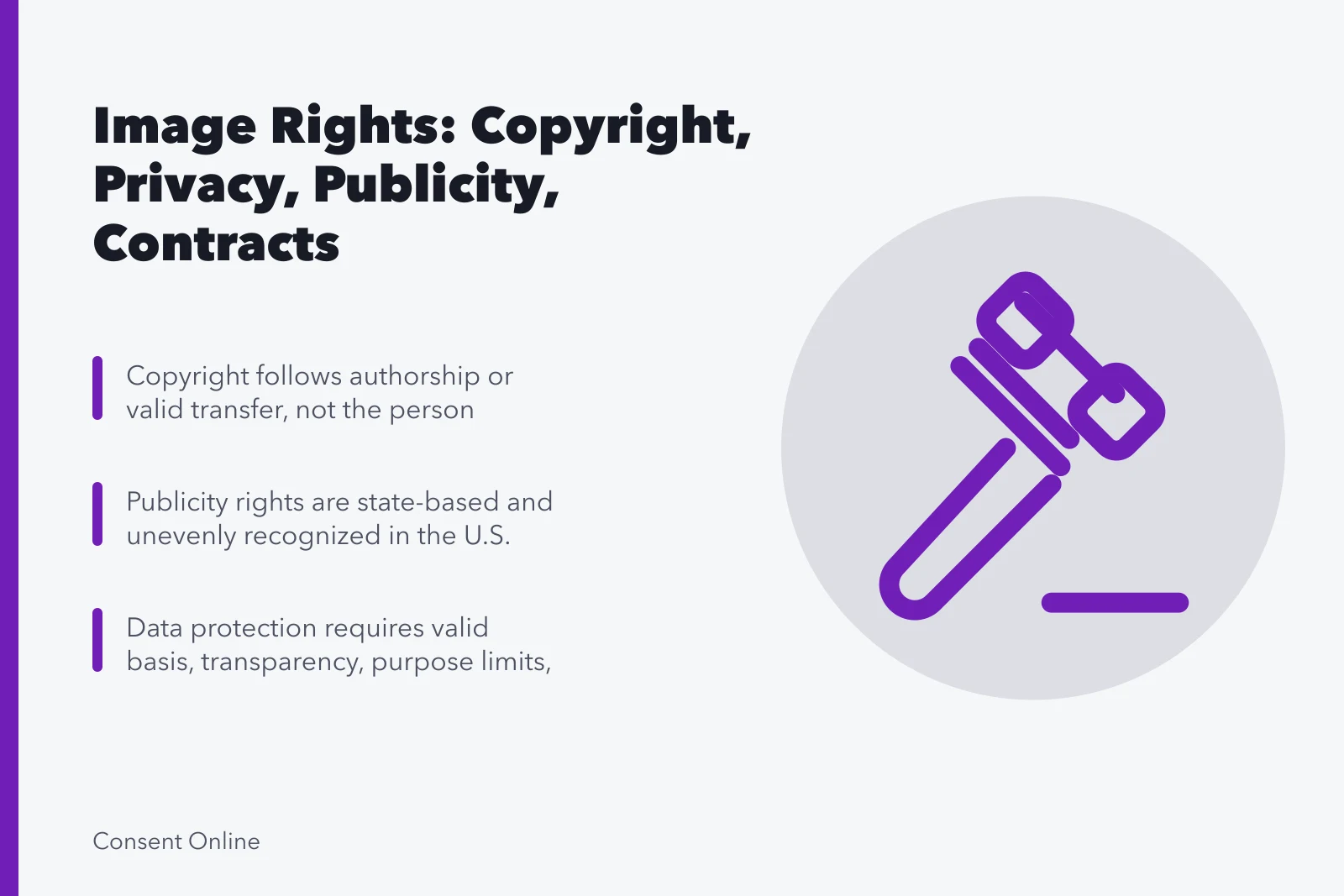
- Copyright usually follows authorship or a valid transfer, not the identity of the person pictured.
- Privacy asks about intrusion, private facts, context, and lawful handling, depending on jurisdiction.
- Publicity focuses on commercial use of identity and is not uniform across the United States or the world.
- Contracts and confidentiality duties depend on the parties, wording, authority, scope, and enforceability.
- Defamation concerns false factual meaning and reputational harm, not merely an unflattering photograph.
- Platform rules are private service terms and policies, not complete statements of law.
One photograph can involve several people and several rights. The photographer may own the image copyright, the subject may hold privacy or publicity interests, an agency may have a license, and a brand may have a narrow release. None of those facts automatically answers the others. This guide provides issue spotting, not legal advice.
Start with the actors and conduct
List the creator, depicted people, client, employer, agency, publisher, platform, and current claimant. Then describe the challenged conduct: capture, access, copying, editing, captioning, sale, advertisement, disclosure, training, or reposting. Rights attach to specific acts and parties.
Actors to challenged conduct
- Creator, depicted person, client, employer
- Agency, publisher, platform, claimant
- Capture, access, copying, editing
- Captioning, sale, advertisement, disclosure
- Training, reposting
Copyright
Copyright can protect original photographic expression. Initial ownership often belongs to the photographer, subject to employment, work-made-for-hire, joint-authorship, and transfer rules. Owning a print or being pictured does not itself transfer copyright.
Copyright ownership and license check
- Original photographic expression
- Employment or work-made-for-hire
- Joint authorship
- Transfer rules
- License scoperights, channels, territories, dates
- Registration may affect remedies
A license can authorize only specified rights, channels, territories, or dates. Copyright exceptions and limitations vary. Registration may affect remedies and procedure even when protection began earlier.
Privacy and data protection
Privacy is not one global claim. It can include intrusion, public disclosure of private facts, false light in some U.S. jurisdictions, confidentiality, or constitutional and statutory protections. Location, expectation, newsworthiness, public interest, and sensitivity can matter.
Data-protection systems ask whether an identifiable person's information is processed under a valid basis with transparency, purpose limits, minimization, security, retention, and rights. A photograph is not automatically biometric data merely because a face appears; technical use for recognition can change the analysis.
Publicity and commercial identity
Publicity law can protect a person's name, likeness, voice, signature, or other recognizable identity from unauthorized commercial exploitation. Cornell's Legal Information Institute explains that U.S. publicity rights are largely state-based and unevenly recognized. That overview does not decide whether a particular editorial, expressive, advertising, or cross-border use is actionable.
Do not label every unwanted image a publicity violation. Identify the commercial message, identity cue, jurisdiction, consent, and applicable exceptions or speech protections.
Contract and confidentiality
Contracts can allocate capture, ownership, license, approval, payment, credit, disclosure, retention, and termination. A release may waive or authorize defined claims without transferring copyright. An agency cannot grant more authority than it holds.
Confidentiality may arise from an agreement, professional duty, employment relationship, or law. Marking a file "confidential" is evidence of an expectation, not automatic proof of an enforceable obligation against every recipient.
Defamation and false context
An authentic image can be paired with a false caption or arranged to imply a false factual association. Defamation rules vary, including fault standards, public-figure treatment, opinion, truth, privilege, harm, and deadlines. False light is not recognized everywhere.
Correct verified errors promptly without admitting a legal conclusion that has not been reviewed. Preserve the original publication and correction record.
Platform rules
A service may ban impersonation, privacy invasion, harassment, or unauthorized intimate imagery beyond what a court would order. Its upload license may permit technical operation without granting users rights in third-party material. Policy removal does not prove legal liability, and legal ownership does not guarantee policy removal.
Common questions
Does the subject own a portrait?
The subject may own a copy or have personal rights, but the photographer or another author may own copyright. Contracts and law can change that result.
Does a model release transfer copyright?
Not unless its valid terms do so. Many releases address likeness use rather than ownership of the photograph.
Is every commercial website use an endorsement?
No. Placement, message, identity use, audience understanding, consent, jurisdiction, and exceptions need review.
Which claim should a report name?
Name only the issue the claimant can support with facts and authority. Several separate routes may apply, but they should not be blended carelessly.