Guides
Synthetic image consent guide: face swaps, voice clones, training data, prompts, disclosure, provenance
Synthetic image consent covers face swaps, voice clones, source files, biometric templates, training data, prompts, disclosure, provenance, and removal routes.
What to take away
- A public portrait is not permission to build a face swap, clone a voice, or generate a digital double.
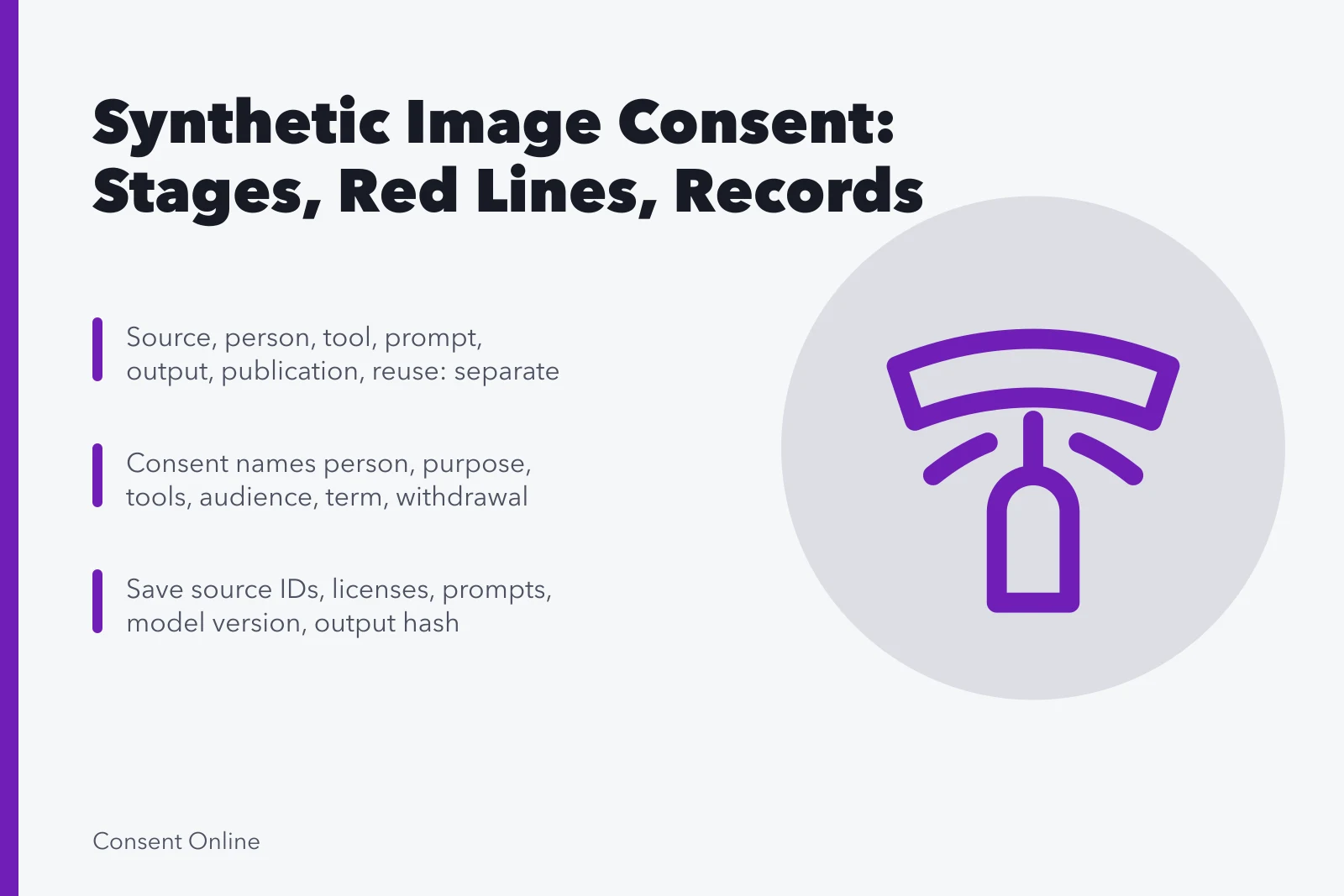
- Source, model, output, publication, and reuse are separate stages, each with its own permission.
- Consent names the person, purpose, tools, audience, term, editing limits, and withdrawal process.
- Disclosure reduces deception; it does not repair missing permission.
- Provenance records describe a file's history, not the truth of every claim or the lawfulness of every use.
- Intimate, political, medical, financial, and endorsement contexts need stricter refusal rules.
Synthetic media is content substantially generated or modified by algorithms. It supports art, localization, accessibility, and production. It also misrepresents a person at scale. The useful question is not whether the output looks real. Ask what was used, what the work communicates, who could be harmed, and whether each right exists.
Map the production chain
One broad permission form hides the stage that failed. Keep a record per stage instead.
| Stage | Questions to resolve |
|---|---|
| Source | Whose face, voice, or body is in the input, and who agreed? |
| Model | What data trains the system, and whose likeness does it hold? |
| Output | Who reviews the item, and which red lines does it touch? |
| Publication | Who sees it, where, and under what label? |
| Reuse | Can it train another model, run in ads, or be edited? |
Synthetic media production stages
- Source: who made and owns each file?
- Person: who is identifiable by face or voice?
- Tool: may service retain or train on inputs?
- Prompt: does instruction create sensitive or deceptive context?
- Output: what changed and could it pass as real?
- Publication: which channels, territories, audiences, dates?
- Reuse: may anyone remix, download, or sublicense?
- Exit: how are files and access handled?
Obtain specific permission
The person should know whether the project copies a face, voice, gesture, or style. They should know whether new words or acts will be attributed to them.
Specific permission checklist
- Copies face, voice, gesture, or style?
- New words or acts attributed to person?
- Purposepromotional, fictional, educational, political, sexual, private?
- Named human reviewers and vendors with input access?
- Source photography consent separated from model training?
- One approved line not consent to every generated script?
Political use needs campaign, region, and a stop date. Sexual use needs documented authorization or a refusal. Private use forbids later publication.
Do not bundle source photography consent with model training or unlimited future generation. A performer who records one approved line has not agreed to every script that could be generated in the same voice.
Template clause: [Person] permits [Company] to train a voice model on the named recordings for [purpose]. Tools: [vendor, version]. Audience: [channel]. Term: [24 months]. Edits may change pacing, not wording or meaning. Withdrawal: any time in writing, then deletion of the model and published copies within [30] days.
Set red lines before production
Refuse outputs that place a person in an intimate situation without explicit, informed authorization. Apply child-protection safeguards even when the person depicted is synthetic or the source portrait was ordinary. Do not create fake admissions, medical claims, financial instructions, political messages, or product endorsements without a valid and reviewed basis.
Red lines before production
Intimate situation without explicit authorization?
Refuse output
Apply child-protection safeguards
Risk shifts with audience. A clearly fictional clip shown privately to the participant is not the same as a realistic ad aimed at strangers. Put the disclosure where viewers meet the media, not in a profile they may never open.
Keep evidence of origin and change
Keep dated records for each item.
- source files and their rights status
- the signed consent record
- model name, version, provider
- prompts, seeds, settings
- output versions and edits
- the approving reviewer
- the published disclosure text
- dates, channels, licensees
- the removal log
Evidence of origin and change
- Source IDs
- Licenses
- Releases
- Approved prompts
- Model and version
- Generation date
- Operator
- Edits, disclosures, output hash, review decisions, publication list
Restrict identity documents and raw face or voice files. A rights record should say what a source proves and what it does not.
NIST's report on technical approaches to synthetic-content transparency covers provenance, watermarking, detection, and related methods. It also warns that technical measures cannot comprehensively address all harms. Treat those tools as signals, not as substitutes for consent, editorial review, or legal analysis.
Plan disclosure and removal
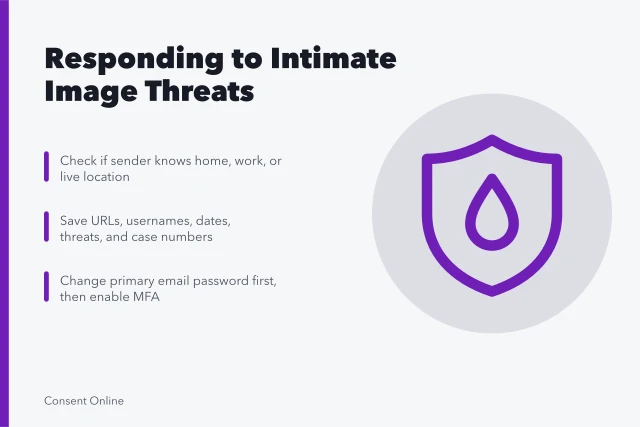
Use plain language such as "synthetically generated voice with the speaker's permission" when that is accurate. Do not use a generic label to hide a material change. Keep a contact route for the depicted person, a rapid pause process, version-specific takedown instructions, and a record of every distributor.
Disclosure and removal routes
- Use plain language disclosure
- Keep contact route for depicted person
- Rapid pause process
- Version-specific takedown instructions
- Record every distributor
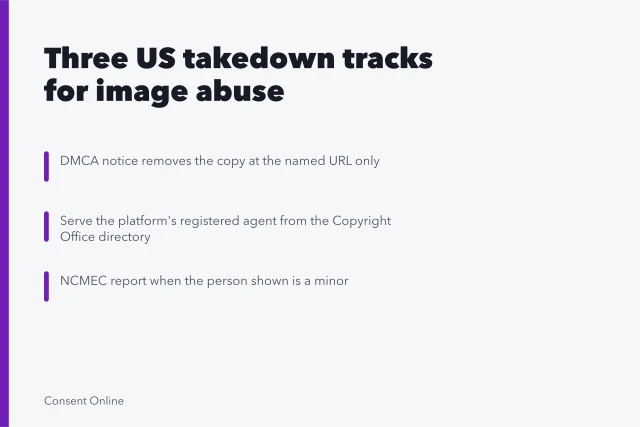
- Removal may involve publisher, platform, host, search, licensee, vendor
Removal may involve several parties:
- the publisher
- platform
- host
- search service
- licensee
- model vendor Meta, Twitch, and Google each run their own report flows, and a host or registrar notice reaches a different decision-maker than a platform report does.
Work in this order.
- Publisherask for a pause and a version list.
- Platformreport the exact version.
- Hostnotify the host and registrar carrying the file.
- Searchrequest removal of indexed copies.
- Licenseetell the republisher to pull its copy.
- Model vendorremove the fine-tune.
A rights holder can weigh several legal routes:
- copyright
- privacy
- publicity
- contract
- consumer-protection
- defamation
- data-protection Which route applies depends on the facts and the jurisdiction, so confirm it with a licensed attorney there.
In the United States, that map includes several laws. These cover copyright, endorsement, identity, and health-data claims:
- The Digital Millennium Copyright Act for copyright claims
- The FTC endorsement guides when a synthetic figure appears to endorse a product
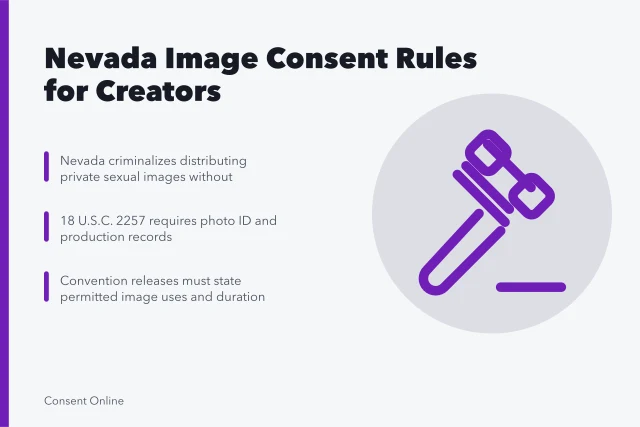
- State non-consensual intimate image statutes such as Illinois BIPA
- Washington's My Health My Data Act
- Nevada NRS 200.575 for identity and health-data claims
Each sets its own requirements. None of them is self-executing, and none substitutes for local counsel.
Common questions
Is disclosure enough without consent?
No. Disclosure tells viewers something about the media, and it does not authorize use of a person's likeness, voice, work, or personal data.
Does a licensed photograph permit a face swap?
Not necessarily. The license may cover copyright in the photograph but not the subject's likeness, the sensitive context, model input, or implied endorsement. Those are separate rights held by separate people.
Can provenance prove an image is true?
No. It can record origin and processing claims and show certain tampering. Truthful interpretation still needs evidence and context, and a provenance record can be attached to a false claim.
Should prompts be retained forever?
No. Keep them only for a defined operational, safety, contractual, or legal need. Apply access controls and a deletion rule, and say in the consent record how long that is.