Rules
Part of Image rights guide: copyright, privacy, publicity, contract, confidentiality, data protection
Image rights claim problems: common pitfalls
Image rights claim problems can involve ownership, fair use, licensing, releases, changing context, confidentiality, and legal threats. Learn what to check.
What to take away
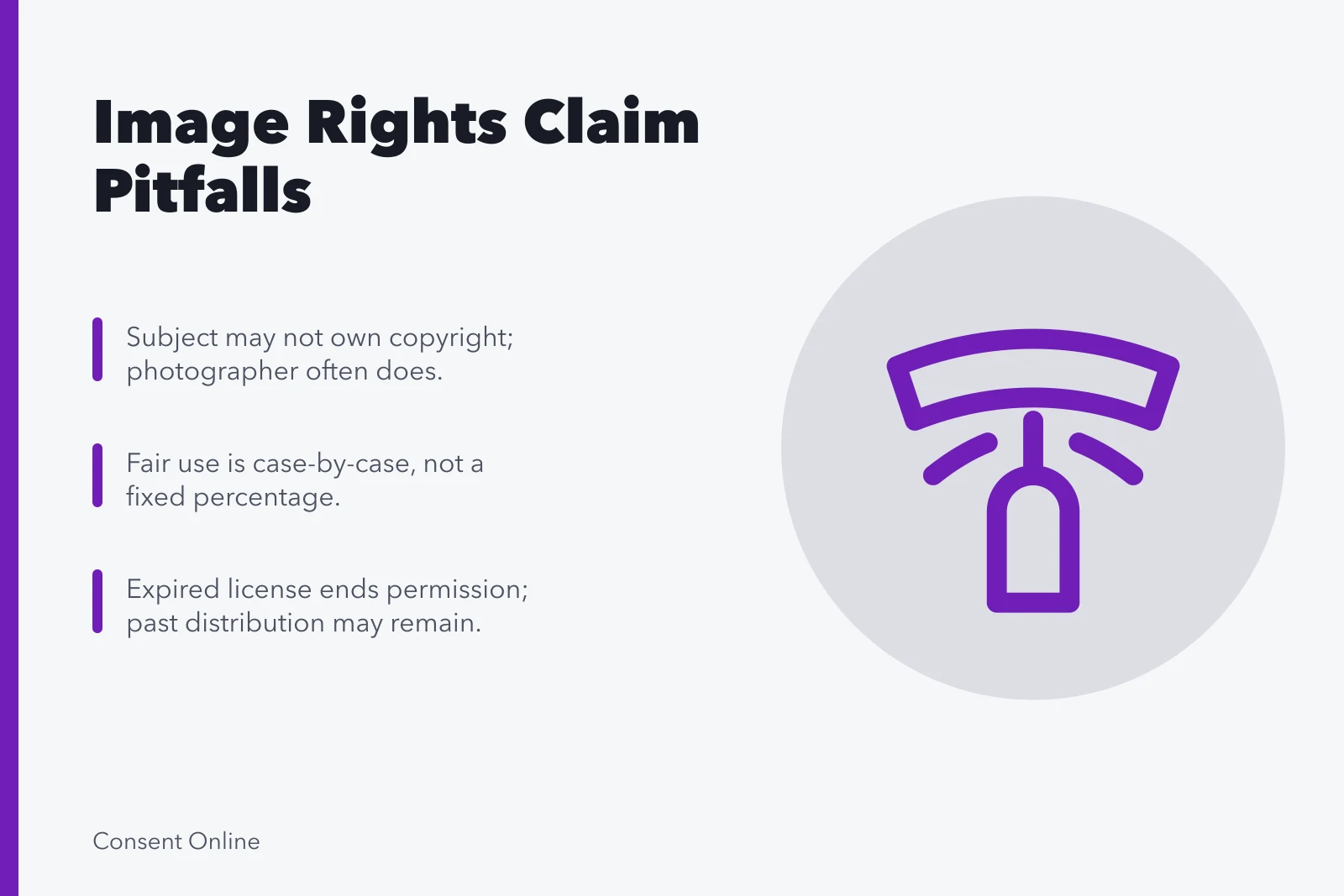
- A person shown in a photograph may not own its copyright.
- Fair use is a fact-specific U.S. analysis, not a fixed percentage or automatic label.
- An expired license can end permission without transferring ownership back or deleting every authorized copy.
- A missing release is a risk signal, not automatic proof of every possible claim.
- New captions, products, audiences, or synthetic edits can exceed an earlier scope.
- Overbroad legal threats can undermine a valid narrow complaint.
Image rights claim problems become harder when teams skip role and document checks. The safest working method is to identify the person, work, agreement, act, jurisdiction, and desired remedy before naming a claim. This page flags recurring mistakes and does not provide legal advice.
Wrong claimant
A subject may have privacy, publicity, contract, or data rights while the photographer owns copyright. A brand may hold a license but not ownership. An agency may act only within granted authority.
Publicity rights come from state law, and their scope varies by state. Examples include California Civil Code § 3344 and New York Civil Rights Law §§ 50–51; the relevant law depends on the facts and jurisdiction.
Confirm authorship, employment, transfer, agency, and current ownership. Do not submit a penalty-of-perjury copyright notice based only on being pictured or paying an invoice.
For copyright, the notice-and-takedown process is in the Copyright Act, 17 U.S.C. § 512, commonly called the DMCA process. A notice identifies the copyrighted work and the material and location at issue, and includes required statements about good faith, accuracy, and authority to act. A service provider may remove or disable access; the uploader can submit a counter-notice, which may lead to restoration unless the claimant takes the required legal action. This process addresses copyright claims, not every privacy or publicity dispute.
Fair-use assumptions
Common myths include "under 10 percent is safe," "credit makes it fair," "nonprofit use is always fair," and "anything online is free." U.S. fair use weighs statutory factors in context.
The Copyright Act, 17 U.S.C. § 107, names four fair-use factors: the purpose and character of the use; the nature of the copyrighted work; the amount and substantiality of the portion used; and the effect of the use on the work’s potential market or value. Courts weigh them together; no single factor or label decides the question.
Fair Use Myths vs. Reality
Common Myth
- 10% rule
- No preset amount is safe
- Credit
- Credit does not make use fair
- Nonprofit
- Nonprofit is not always fair
- Online content
- Online is not automatically free
What Courts Actually Do
- 10% rule
- Case-by-case analysis
- Credit
- Context and purpose matter
- Nonprofit
- Statutory factors weighed
- Online content
- Permission may still be required
The U.S. Copyright Office Fair Use Index explains that courts assess fair use case by case, that no preset amount guarantees permission, and that the index summarizes selected decisions rather than replacing the opinions or legal advice. Other countries use different exceptions.
Expired or exceeded licenses
A valid license can end by date, territory, channel, campaign, use count, or termination. After expiry, new publication may lack permission, while past authorized distribution can remain governed by the agreement. Archives, sold goods, printed stock, and platform caches need explicit treatment.
Compare the exact file and use with the grant. Do not infer perpetual rights from a missing end date without reading governing law and the agreement as a whole.
Missing releases
A missing subject release can expose commercial, privacy, and contract risk, but it does not itself prove copyright infringement or unlawful capture. Oral agreements, notices, conduct, law, editorial protections, and institutional rules may matter.
A release should make the scope understandable: whose name or likeness may be used, the permitted media and purposes, any limits on edits or association with products, the term and territory, and any compensation. It should identify the parties and be signed by someone authorized to consent; if the subject is a minor, confirm who can give permission. A release is not automatically a copyright license for the photograph.
Pause avoidable publication until authority is clear. Do not fabricate or backdate a release. If a party agrees to new terms, record the present agreement honestly.
Changed context
A portrait approved for a staff directory can become a product endorsement when placed beside a sales claim. A documentary still can become misleading when cropped or captioned. A licensed voice sample can become a new synthetic performance.
Review product, message, audience, channel, edit, territory, term, and paid distribution. New context may require new approval even when the underlying file is unchanged.
Confidentiality gaps
An NDA can define protected information, permitted recipients, duration, return, deletion, and exceptions. Cornell's overview of non-disclosure agreements describes them as contracts and notes statutory and public-policy limits. A confidential label alone does not bind strangers who never accepted a duty.
Keep the specific clause and disclosure facts separate from privacy or copyright claims. Whistleblower, crime-reporting, employment, and statutory protections require qualified review.
Overbroad threats
Demands that claim every right, threaten impossible penalties, or require global deletion can distract from a strong, verifiable issue. State the exact work, person, URL, agreement, false statement, or data use and ask for a remedy the recipient controls.
For copyright complaints, platforms have their own routes: YouTube Studio’s copyright removal request, Meta’s intellectual-property report form for Facebook and Instagram, and TikTok’s intellectual-property infringement report form. Choose the route that matches the right at issue and follow the platform’s required process; a copyright report is not a substitute for a privacy or non-consensual intimate-image report.
Do not threaten criminal action to obtain private payment. Preserve communications and have urgent or high-value claims reviewed by counsel.
For eligible copyright disputes, a claimant may also consider the Copyright Claims Board (CCB), which handles claims through the Copyright Office’s eCCB system. It is a voluntary alternative to federal court, and a respondent may opt out; it is not a platform takedown route.
Common questions
Does credit cure infringement?
No. Credit can satisfy an attribution term but does not by itself supply a copyright license or exception.
Does an expired license erase prior lawful uses?
Not automatically. Read survival, archive, sell-off, deletion, and termination clauses under governing law.
Can a missing release be fixed later?
A new agreement may authorize future or specified past uses if valid, but it should not be backdated or obtained through pressure.
Should every demand ask for damages?
No. Removal, correction, credit, restriction, preservation, disclosure, or a negotiated license may better fit the evidence and goal.