Guides
How to run a consent review before creating or publishing synthetic media of a person
A synthetic media consent review checks the source files, the identifiable person, the tool contract, the output and the removal plan before anything goes public.
What to take away
- Freeze publication until source, person, tool, output and distribution are reviewed.
- Identify people through voice, body, context and mannerisms, not only faces or names.
- Read current model terms for retention, training, human review and reuse.
- Show the person the real output and the surrounding message before final approval.
- Record the disclosure wording and its placement for every channel.
- Write the stop and removal process before the first release.
This workflow suits a legitimate project using an adult's likeness or voice. It is not a method for laundering scraped material into permission. Here are the uses it does not replace legal review for:
- intimate
- political
- medical
- financial
- biometric
- employment
- child-related uses
Write the proposed representation first
Describe what the audience will see or hear in one paragraph. Name the person, the conduct, the words, and the product. Name the setting, the realism, the channels, and the languages. Name the dates and the paid promotion. If that description sounds broader than the participant expects, stop before making a test.
Describe the proposed representation
- Name the person and conduct
- Name the words and product
- Name setting, realism, channels, languages
- Name dates and paid promotion
- Stop if broader than expected
- Separate demo from publication
Separate a technical demonstration from publication. A closed prototype approval does not permit a public campaign.
Inventory the inputs
For each portrait, clip, voice sample, script or reference, record who created it and who owns the copyright. Note the people depicted or audible, and where and when the file was acquired.
Inventory every input file
- Record creator and copyright owner
- Note people depicted or audible
- Note where and when acquired
- Record license or release scope
- Check metadata and hidden identifiers
- Note deletion or return requirement
Then record the license or release and its scope. Note whether the file carries metadata or hidden identifiers, and whether it may enter a hosted model. Note any deletion or return requirement.
Do not upload identity documents, unreleased masters or third-party images merely because the tool accepts them.
Review the person and the context
Ask whether an ordinary viewer could identify the person from face, voice, body, or name.
Can an ordinary viewer identify the person?
Could an ordinary viewer identify the person from face, voice, body, or name?
Rate the proposed context for harm
Check account, location, and combined clues
Several uses can harm even when the synthetic element is labeled:
- Sexualized uses
- Criminal uses
- Medical uses
- Political uses
- Financial uses
- Employment uses
- Grief uses
- Religious uses
- Endorsement uses The 2026 international regulator statement on AI-generated imagery calls for safeguards against misuse of personal information and nonconsensual intimate imagery.
Its signatories also call for meaningful transparency, accessible removal mechanisms and stronger protection for children. Exact legal duties vary by jurisdiction, so confirm them with a licensed attorney where you operate.
Inspect the tool contract
Capture the service name, plan, model, version, region and review date. Check whether inputs or outputs are retained, used to train systems, reviewed by people, shared with vendors or made public. Note any broad license grant.
Inspect the tool contract
- Capture service, plan, model, version, region, date
- Check input and output retention
- Check training use and human review
- Check vendor sharing and public release
- Note broad license grants
- Record account controls and deletion limits
Record the account controls and the deletion limits. If the contract conflicts with the person's approved limits, change the tool or the project. A private workspace label is not evidence of technical isolation.
Approve the output, not an idea
Show the person the final file, the caption, the landing page, the product, the disclosure and the nearby claims. Give enough time to review without a producer waiting on a live call. Record accepted and rejected versions separately.
Approval should name the exact items:
- channels
- dates
- territories
- languages
- paid media
- edits
- derivative variants Any material change returns for review.
Add disclosure and provenance
Write a visible statement that identifies the synthetic element and the permission where it is known. Do not say "authorized" if only the photograph was licensed.
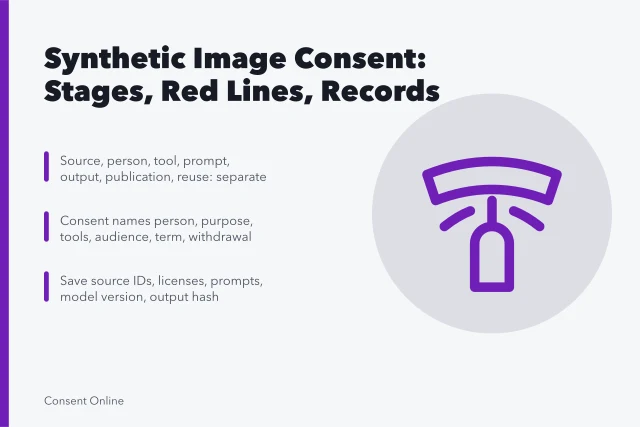
Keep the source list, the prompt record, the model details and the output hash. Keep the edit log, the reviewer name, the disclosure text and the release identifier with them.
Test whether the disclosure survives crops, reposts, autoplay, small screens, audio-only playback and translation. Keep a plain caption even when technical credentials are embedded.
Prepare withdrawal and response
Assign an inbox, a decision owner, a backup contact, a pause switch, a distributor list and a response deadline. Write who can stop paid placement and who can request platform, host or search action. Revoke shared access and expire downloadable assets at campaign end.
Common questions
Can a participant approve through a text message?
Possibly, but clarity and enforceability depend on context and law. A structured record showing the viewed output and the precise scope is safer. Ask a licensed attorney in your jurisdiction what your record needs to hold.
Must every edit return for approval?
Define acceptable technical edits in advance. New words, acts, products, sensitive contexts or materially different realism should return for review.
What if the model terms change?
Record the reviewed version and set a recheck date. Pause new uploads when a change could expand retention, training, review or licensing.
Does deleting the output delete the inputs?
Not necessarily. Follow the service's separate input, output, account, retention and backup procedures.