Reviews
Part of Image rights guide: copyright, privacy, publicity, contract, confidentiality, data protection
Image rights claims compared: ownership, permission, publicity, privacy and contract
Image rights claims compared by ownership, subject permission, publicity, privacy, data protection, defamation, contract, defenses, evidence, and remedies.
What to take away
- Photographer ownership and subject permission answer different questions.
- Publicity and privacy protect different interests and vary across jurisdictions.
- Data protection governs processing of identifiable-person information under a statutory framework.
- Defamation requires false factual meaning and other jurisdiction-specific elements.
- Contract claims depend on actual parties, authority, and terms.
- The same publication can support one claim, several claims, or none after defenses and exceptions are considered.
This comparison of image rights claims is a sorting tool, not a verdict. Exact rules, defenses, remedies, deadlines, and takedown routes depend on the governing law and the facts.
Comparison table
Image Rights Claims at a Glance
Ownership
- Protected interest
- copyright in expression
- Main evidence
- source files, authorship, transfer
- Common mistake
- assuming subject owns copyright
Permission
- Protected interest
- authorized capture or use
- Main evidence
- release, notice, scope
- Common mistake
- treating one use as unlimited consent
Publicity
- Protected interest
- commercial control of identity
- Main evidence
- identity cue, commercial context
- Common mistake
- applying one state's rule worldwide
Privacy
- Protected interest
- private life and seclusion
- Main evidence
- setting, expectation, disclosure
- Common mistake
- assuming public location ends privacy
Protected interest
- Photographer ownership
- copyright in original expression
- Subject permission
- authorized capture or use of the person
- Publicity
- commercial control of identity
- Privacy
- private life, seclusion, facts, or false light where recognized
- Data protection
- lawful and fair processing of personal data
- Defamation
- reputation against false factual communication
- Contract
- promised performance and allocated rights
Main evidence
- Photographer ownership
- source files, authorship, employment, transfer
- Subject permission
- release, notice, communication, scope
- Publicity
- identity cue, commercial context, consent
- Privacy
- setting, expectation, content, disclosure
- Data protection
- purpose, basis, notice, recipients, retention
- Defamation
- exact caption, implication, falsity, fault, harm
- Contract
- signed terms, authority, amendments, conduct
Common mistake
- Photographer ownership
- assuming the subject owns copyright
- Subject permission
- treating one use as unlimited consent
- Publicity
- applying one state's rule worldwide
- Privacy
- assuming public location ends all privacy issues
- Data protection
- treating consent as the only basis
- Defamation
- calling any embarrassing image defamatory
- Contract
- reading a release as a copyright transfer
Photographer ownership
In the United States, 17 U.S.C. § 106 gives the copyright owner the exclusive rights to reproduce, distribute, display, and prepare derivative works from the image, and § 201(a) vests initial ownership in the photographer. A work made for hire under § 201(b) — typically an employee shooting within the scope of employment — puts ownership in the employer instead, and registration is a precondition to suing over a U.S. work under § 411(a). The U.S. Copyright Office's photograph registration circular also explains that copyright protects the photographer's creative choices, including positioning, lens, angle, lighting, and timing. That rule does not by itself answer a subject's separate permission or identity claim.
Other countries can apply different authorship, employment, moral-rights, and commissioning rules. A license may split exclusive rights by channel, territory, or term.
Subject permission and publicity
Subject permission can govern capture, display, promotion, editing, or defined reuse. It is evidence of authorization, not necessarily a transfer of the image copyright.
Publicity claims focus on commercial exploitation of identity and are governed state by state. California's statutory right of publicity is Cal. Civ. Code § 3344, New York's is N.Y. Civ. Rights Law §§ 50–51, and many other states rely on common law or a narrower statute. A claim may cover name, face, voice, signature, or other persona cues. Editorial, expressive, news, public-interest, and First Amendment protections can limit it, depending on jurisdiction.
Privacy and data protection
Privacy is not one claim but several. U.S. courts and treatises usually describe four privacy torts — intrusion upon seclusion, public disclosure of private facts, false light, and appropriation — restated in the Restatement (Second) of Torts, and states adopt them to different degrees. Analysis can involve the place and method of capture, sensitive facts revealed, audience, expectation, newsworthiness, and whether a false impression is highly offensive where false-light law exists. Public availability of one fact does not authorize every new context.
Data protection asks whether the image relates to an identifiable person and how an organization processes it. In the EU, the General Data Protection Regulation (GDPR) requires a lawful basis under Article 6 and adds a right to erasure under Article 17. In California, the CCPA as amended by the CPRA gives rights to know, delete, correct, and limit the use of sensitive personal information. Purpose limitation, transparency, minimization, access, security, retention, and rights requests may apply. Biometric treatment needs specific technical processing in many frameworks; Illinois's Biometric Information Privacy Act is one example.
Defamation
An image can communicate a false meaning through captions, cropping, sequencing, labels, or placement. Cornell's current defamation overview describes a general U.S. structure of false factual statement, publication, required fault, and legally recognized harm while emphasizing state variation, speech protections, public-figure standards, truth, opinion, and privilege. The public-figure fault standard comes from N.Y. Times Co. v. Sullivan, which demands knowledge of falsity or reckless disregard — actual malice — while private figures generally need only negligence under Gertz v. Robert Welch, Inc.
A technically authentic image is not a defense to a false caption. An unflattering but true presentation is not automatically defamation.
Contract
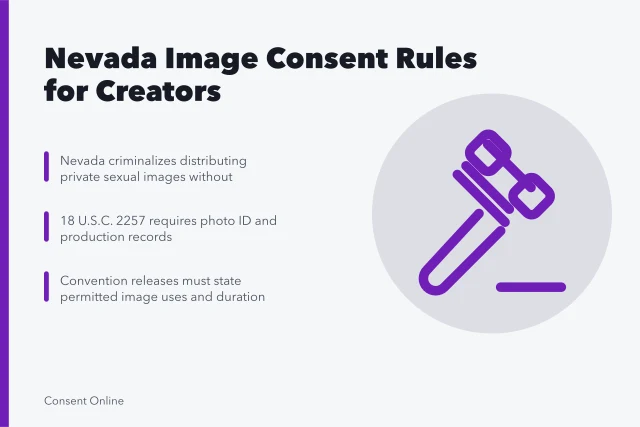
Contracts bind parties according to valid terms and applicable law. A photographer-client agreement can address delivery and license; a model or subject release can authorize likeness use for stated media, term, and territory; an agency agreement can define authority; and a platform contract can permit technical distribution. Release forms typically state the grant of rights, the permitted uses, the term, the territory, and the governing law.
Identify the clause, party, breach, excuse, remedy, limitation, governing law, and deadline. Do not turn a third party into a contracting party without a valid basis.
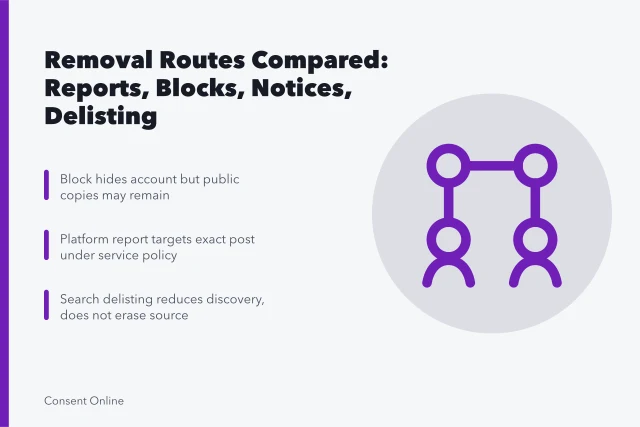
Online takedowns and platform reporting
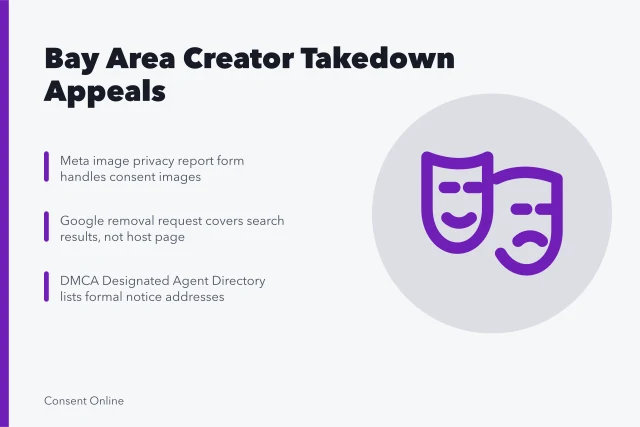
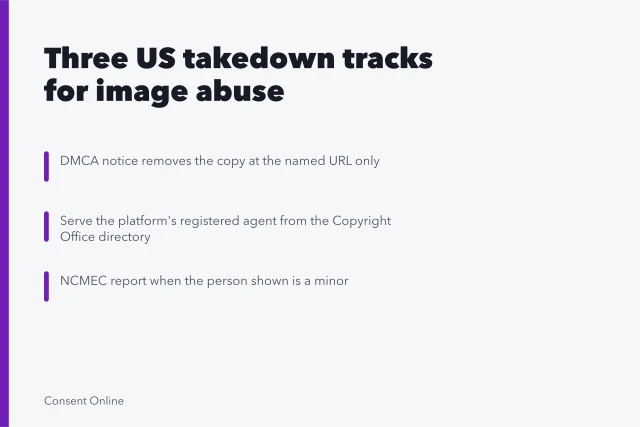
DMCA notice-and-takedown under 17 U.S.C. § 512(c) belongs to the copyright owner or an authorized agent, and the notice must go to the platform's designated agent, listed in the U.S. Copyright Office's DMCA Designated Agent Directory. The platform then removes or disables the material, and the uploader can answer with a counter-notification under § 512(g); knowingly false notices expose the sender to damages under § 512(f).
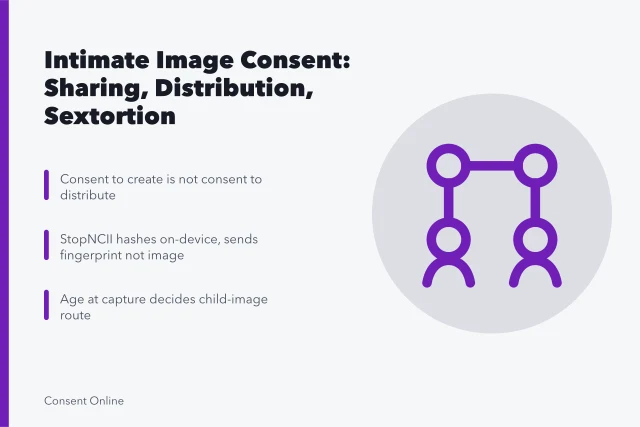
Claims that belong to the person in the image do not run through DMCA. For non-consensual intimate images the routes are the platform's own reporting flow and hash-matching tools such as StopNCII.org, which let participating platforms block re-uploads. Section 230, 47 U.S.C. § 230, shields platforms from most user-content claims, with exceptions that include federal criminal law and the trafficking provisions added by FOSTA-SESTA.
Common questions
Can copyright and publicity both apply?
Yes. One protects the work and the other may protect commercial identity. The owners, defenses, and remedies can differ.
Does a release defeat every privacy claim?
No. Scope, validity, context, law, misleading use, data practices, and later conduct still matter.
Can a true photo be defamatory?
The image itself may be authentic while its caption or arrangement communicates a provably false factual meaning. Qualified advice is needed.
Which right is strongest?
There is no universal ranking. Strength depends on claimant, evidence, forum, defenses, deadlines, and the remedy sought.